Guide
Commercial Kitchen Equipment Troubleshooting by Symptom
Symptom-first troubleshooting for reach-ins, ice machines, fryers, ovens and dish machines: safe staff checks, food-safety limits and when to call.
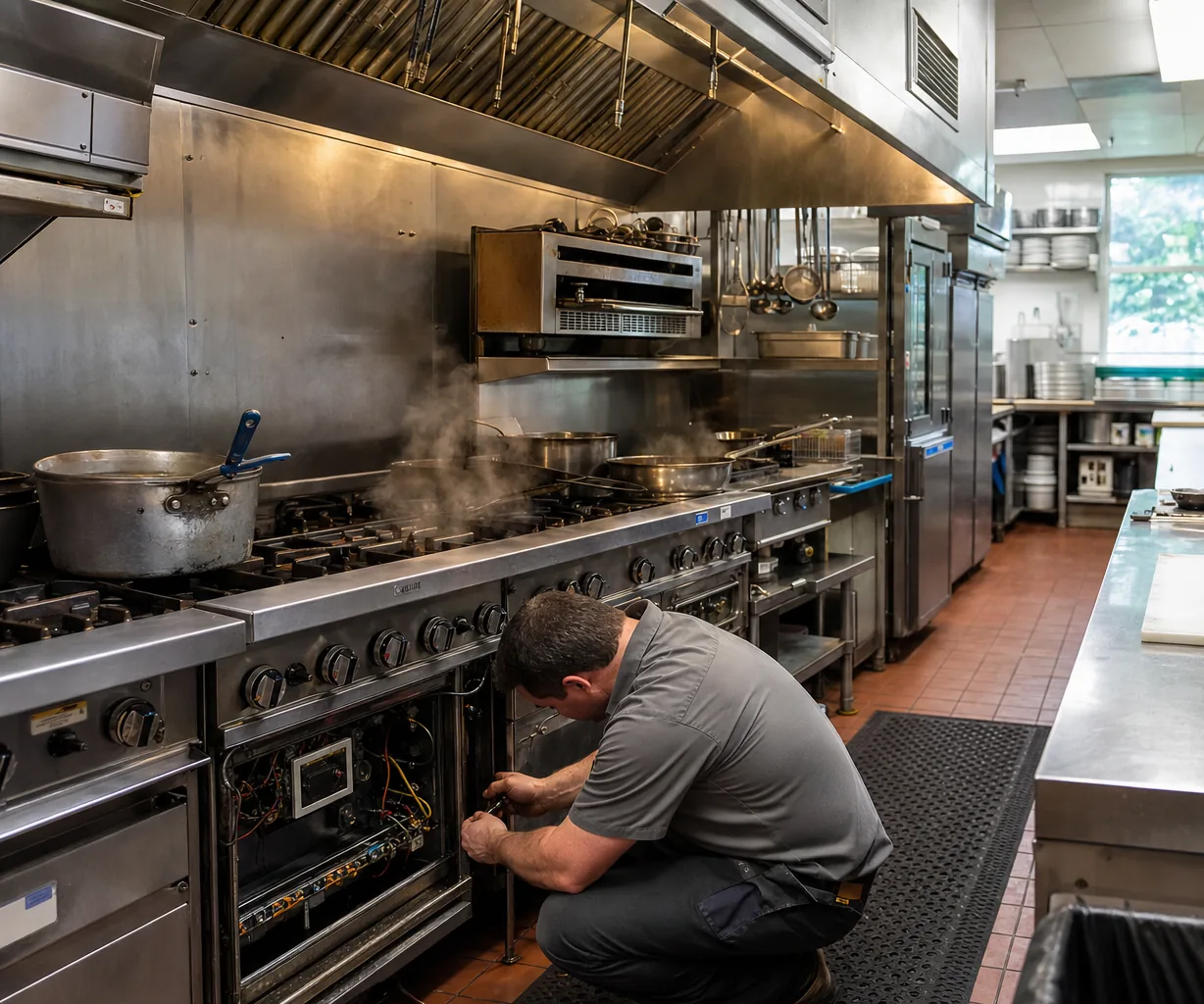
Commercial kitchen equipment troubleshooting works best symptom first: confirm power, gas and water, then read the unit’s real temperature against the 41°F cold-holding and 135°F hot-holding targets before anyone opens a panel. Those 5 safe checks take about 10 minutes, and if they don’t clear the problem, a diagnostic visit is a typical $95–$165, with the service call fee credited toward the repair.
This guide helps Yonkers owners, chefs and kitchen managers decide fast: keep cooking, move product, or call.
What should staff check first on any unit?
Run these five checks in order. None needs tools or a panel removed.
- Power and controls. Is the unit plugged in, is the breaker or GFCI tripped, and is there an error code on the display? Write the code down.
- Gas, water and drain. Is the gas valve fully open, are other burners on the line lit, is the water supply on, and is the drain clear?
- Actual temperature. Use a calibrated probe thermometer in product, not the unit’s display.
- Airflow and coils. Are the condenser coils matted with grease and lint? Is product blocking the evaporator fan?
- Doors and gaskets. Do doors close on their own and seal all the way around? A torn gasket on a True or Traulsen reach-in can push box temperature up during a rush.
If a check finds an obvious cause, fix it and watch the unit for 30 minutes. If the symptom returns, stop resetting it and call.
Which symptoms point to which failure?
These are typical ranges only; the firm quote is given on site after diagnosis.
| Equipment | Symptom | Likely cause | Safe staff check | Typical range |
|---|---|---|---|---|
| Reach-in or prep cooler | Box creeping above 41°F | Dirty condenser, fan motor, torn gasket | Probe product, check coils and seal | $250–$900 |
| Ice machine | Thin, cloudy or slow ice, no harvest | Scale, clogged filter, water valve | Check water supply and filter date | $350–$1,500 |
| Fryer | Slow recovery, pilot drops out | Thermocouple, thermostat, high limit | Confirm gas valve open, note error code | $200–$800 |
| Oven or range | Won’t reach temperature, uneven bake | Igniter, thermostat, convection fan | Check fan runs, look for clogged ports | $300–$1,200 |
| Griddle or char-broiler | Cold spots, slow heat-up | Burner, thermostat, gas pressure | Compare flame height across burners | $200–$750 |
| Dish machine | Low rinse temperature, dirty dishes | Booster heater, element, wash pump | Read wash and rinse gauges | $300–$1,100 |
In what order do failures usually show up?
Most equipment warns you before it quits, and the early stage is the cheap one.
- Refrigeration: longer run times, a hot condenser area, the box drifting up during rushes, then no recovery overnight. Yonkers summers along the Hudson are hot and humid, and a cramped back room brings that first stage on sooner.
- Ice machines: thinner or cloudier cubes, slower harvests, then no harvest. Scale is the usual cause on Manitowoc and Hoshizaki units, which is why makers call for cleaning and sanitizing at least every 6 months.
- Fryers: slower recovery after a basket drop, a pilot that drops out, then a high-limit trip. Slow recovery means greasy food and longer ticket times before the fryer fails.
- Dish machines: the final rinse falls below the data plate number, glassware spots, then the booster won’t heat. A high-temp Hobart machine should reach 180°F at final rinse.
- Ovens and ranges: uneven or long bakes, slow recovery after loading, then an igniter that won’t light reliably.
How long can food stay out of range before it becomes a loss?
Most kitchens work to the FDA Food Code: 41°F or below for cold food and 135°F or above for hot food. Your local health code sets the exact numbers your inspector checks.
- Log it. Write down the time and temperature when you find the problem; the log drives discard decisions and shows an inspector what you did.
- Use the 4-hour line. A common rule is to discard cold TCS food held above 41°F for more than 4 hours. If you can’t prove when the rise started, assume the worst.
- Move product early. Shift it to a working unit or iced holding once the box passes 41°F instead of waiting to see if it recovers.
When should you shut a unit down instead of nursing it?
Turn it off and call right away for:
- A gas smell. Shut the gas valve, don’t touch switches, and ventilate; if it is strong, leave and call the gas utility or 911 from outside.
- A burning or electrical smell, or a breaker that trips again after one reset.
- Water pooling near electrical connections.
- A fryer that overshoots its set temperature.
Never bypass a high limit or safety switch, and don’t chip ice off an evaporator coil with a knife.
How do you plan the service call so the unit is back fast?
- Photograph the data plate with the model and serial number.
- Note the symptom, when it started, error codes and your temperature log.
- Call before the rush; a morning visit leaves time to source a part.
Call (914) 449-5646. We are an independent service, not manufacturer-authorized, covering Getty Square, South Broadway and Cross County plus Mount Vernon, New Rochelle and White Plains. See commercial refrigeration repair, commercial dishwasher repair, 24/7 emergency commercial repair and our repair pricing.
Frequently asked questions
What is the first thing to check when commercial kitchen equipment stops working?
Check power, gas and water first: the breaker or GFCI, the gas valve and the water supply valve. They are the fastest checks and need no tools.
How much does a commercial appliance diagnostic cost in Yonkers?
A diagnostic or service call is a typical $95–$165, and the service call fee is credited toward the repair. The firm repair quote is given on site after diagnosis.
Can staff keep resetting a fryer that trips its high limit?
No. A fryer that trips its high limit more than once needs a technician, because that switch is the last safety device before the oil overheats.
How often should a commercial ice machine be cleaned?
Most makers call for cleaning and sanitizing at least every 6 months. Clean it sooner if the ice turns thin or cloudy or your water is hard.